Form ES2 Explained: The Composite Asset & Income Schedule
A plain-English guide to Form ES2 — the Financial Remedies Court's composite asset and income schedule. Learn what it is, when to file it, how the Excel template works, and how a litigant in person can complete it accurately.
What is Form ES2?
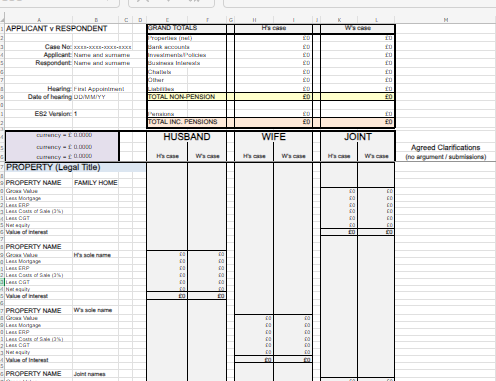
Form ES2 is the Composite Asset and income schedule used in the Financial Remedies Court (FRC). Introduced under the FRC Efficiency Statement (11 January 2022), and now covered by the Financial Remedies Guide 2026, it lays out both parties' finances in a single side-by-side spreadsheet so the judge can see the whole picture at a glance: capital assets, pensions, and income.
Where the ES1 is the narrative, the ES2 is the numbers. It's produced as an Excel template (with a PDF version) and, like the ES1, it's a joint document — both parties cooperate to fill in one shared schedule.
Observational note: This guide describes how the ES2 is generally used in the Financial Remedies Court. It is not legal advice. Always check the current Financial Remedies Guide 2026 and Practice Direction 9A for the position that applies to your case.
When do you have to file the ES2?
The ES2 must be filed before every hearing in contested financial remedy proceedings. The updated ES1 and ES2 must be sent to the court before the FDR, and again before the final hearing. Check your own court order for the deadline.
Key points to remember:
- It is a living document — you update the figures as valuations change and new information comes in.
- Both parties should cooperate to produce one agreed schedule.
- The figures in the ES2 must match the narrative in the ES1 — the two documents tell one story.
- Always download the current template from GOV.UK before you start — the form is updated periodically, so don't rely on an old copy saved to your computer.
How the ES2 template is structured
The ES2 is an Excel spreadsheet (also available as a PDF). It broadly organises the finances into three blocks, with columns for each party's case so disagreements are visible side by side.
1. Capital assets
Property, savings, investments, vehicles, and other chattels — with values and whether they're held solely or jointly.
2. Pensions
Cash Equivalent Transfer Values (CETVs) for each party's pensions, including the Form E valuations.
3. Income
Each party's net income from all sources, and a summary of monthly outgoings where relevant.
For each line, the schedule typically shows:
- The asset or income source
- The applicant's figure (what you say it's worth)
- The respondent's figure (what your ex-partner says it's worth)
- Any agreed figure, or a note of the discrepancy
What documents do you need to complete it?
To fill in the ES2 accurately you'll normally need:
- Your completed Form E and your ex-partner's Form E
- Up-to-date property and pension valuations (including CETVs)
- Bank and savings statements
- Payslips or other income evidence
- The ES1 case summary (the figures must reconcile)
Common mistakes (and what the court can do about them)
- Using an outdated template. The ES2 is updated periodically — always download the latest version from GOV.UK before you start, and discard any old copy.
- Filing late. Check your own court order for the deadline and stick to it. Late filing can lead to costs sanctions or the hearing being adjourned.
- Letting the figures drift out of sync with the ES1. The schedule and the narrative must match.
- Leaving disputed figures blank. The whole point of the ES2 is to show both sides' numbers side by side. Blanks hide the real issues.
- Forgetting to update it. Stale figures from the First Appointment are no use at the FDR. Refresh it before every hearing.
Knowledge is power: The ES2 is one of the first documents the judge reaches for. A clear, complete, balanced schedule lets the court see the shape of your finances in minutes. A broken or partisan one slows everything down.
How a McKenzie Friend can help
A McKenzie Friend cannot give legal advice or conduct your case, but they can:
- Help you open the Excel template and understand what each section is asking for
- Sit with you to enter figures accurately from your Form E and supporting documents
- Help you reconcile the ES2 figures with the ES1 narrative so they match
- Assist with the practical task of cooperating with the other side to produce one agreed schedule
- Help you keep the schedule updated as the case moves through the First Appointment, FDR, and final hearing
Remember: the litigant in person remains fully responsible for the content and filing of the ES2. A McKenzie Friend supports you in doing that work — they don't take it over.
Where to find the official template
- ES2 (Composite asset and income schedule) — Excel and PDF: GOV.UK — Financial remedy summary of finances: Form ES2
- Financial Remedies Guide 2026 (replaces the Efficiency Statement): judiciary.uk
- ES1 template: Financial Remedies Court Notice, judiciary.uk
- Practice Direction 9A: justice.gov.uk
Try the interactive version
One of our McKenzie Friends, Deborah Jones, designed a free interactive ES2 explainer that lets you enter figures into the two "case" columns and see, in plain English, what the form is actually recording — including where figures agree, where they differ, and what that means.
Built by a McKenzie Friend: Try the interactive ES2 explainer on Divorce Navigator →
It's a community contribution, hosted on Divorce Navigator — not part of Bridge The Gap, and not legal advice. We're sharing it because it makes the ES2 genuinely easier to understand. If you've built something that helps litigants, tell us about it — we'd love to credit your work too.
Related glossary terms
Bridge The Gap provides observational insights and collective community experiences only. We do not provide legal advice, legal representation, or caseworker services. Always consult a qualified legal professional for your specific circumstances, and always check the current court rules and FRC guidance before filing.
Walk into court informed, not in the dark.
Explore the full platform — community insights, your journey map, and a 231-term legal glossary.