Form ES1 Explained: The Composite Case Summary in Financial Remedy Proceedings
A plain-English guide to Form ES1 — the Financial Remedies Court's composite case summary. Learn what it is, when you must file it, what goes inside, and how a litigant in person can get it right without a solicitor.
What is Form ES1?
Form ES1 is the Composite Case Summary used in the Financial Remedies Court (FRC). Introduced under the FRC Efficiency Statement (11 January 2022) by Mostyn J and HHJ Hess, and now covered by the Financial Remedies Guide 2026, it gives the judge a concise, single-page snapshot of your case: who the parties are, what the assets look like, and what issues are actually in dispute.
Unlike Form E — which is each party's own detailed financial disclosure — the ES1 is a joint document. Both parties are expected to cooperate and produce one shared summary that sets out, side by side, where they agree and where they don't.
Observational note: This guide describes how the ES1 is generally used in the Financial Remedies Court. It is not legal advice. Always check the current Financial Remedies Guide 2026 and Practice Direction 9A for the position that applies to your case.
When do you have to file the ES1?
The ES1 must be filed before every hearing in contested financial remedy proceedings — not just the Financial Dispute Resolution (FDR) appointment. The updated ES1 and ES2 must be sent to the court before the FDR, and again before the final hearing. Check your own court order for the deadline.
Key points to remember:
- It is a living document — you update it as the case progresses and figures change.
- Both parties should cooperate in preparing it. The court expects a single agreed version where possible.
- It is filed alongside the ES2 (the composite asset and income schedule) so the judge has both the narrative and the numbers.
What goes inside the ES1?
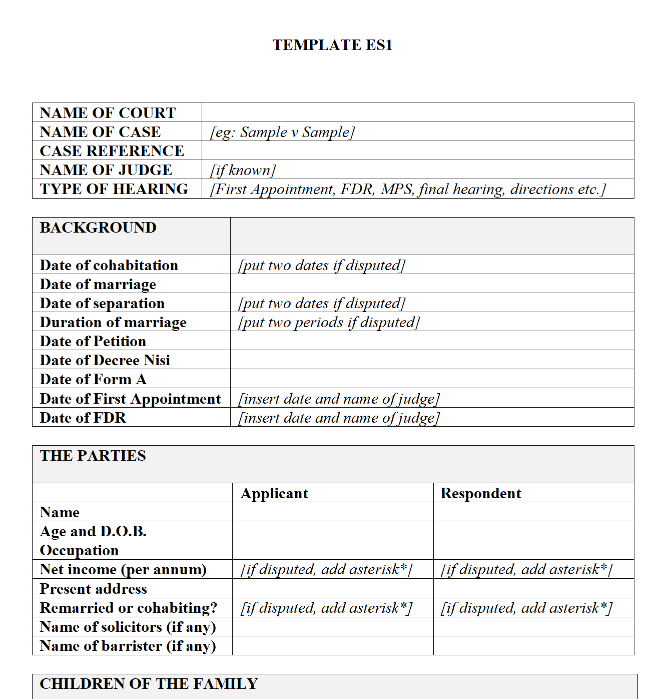
The ES1 is a Word template (available from the judiciary website). While the exact layout follows the official template, it broadly covers:
1. Case background
A short summary of the marriage/civil partnership, its length, the parties' ages, and any relevant health or special circumstances.
2. The parties and any children
Who is involved, where they live, and details of any dependent children — including their ages and arrangements.
3. Summary of the assets
A high-level overview of the capital, pensions, and income position, cross-referenced to the ES2 schedule. This is the narrative companion to the numbers.
4. The issues in dispute
A clear statement of what the parties agree on and what they don't — for example, whether the family home should be sold, how pensions should be split, or whether maintenance should be paid.
5. Each party's open proposals
A short outline of what each side is asking the court to order, so the judge can see the gap between the positions at a glance.
What documents do you need to complete it?
To fill in the ES1 accurately you'll normally need:
- Your completed Form E and your ex-partner's Form E
- Up-to-date valuations of property, pensions, and significant assets
- Recent payslips or income evidence
- The ES2 schedule (the figures should match)
- Any offer letters or open proposals exchanged between the parties
Common mistakes (and what the court can do about them)
- Filing late. Check your own court order for the deadline and stick to it. Late filing can lead to costs sanctions or the hearing being adjourned.
- Treating it as your own document. The ES1 is composite — a one-sided version defeats its purpose and irritates the judge.
- Letting the figures drift out of sync with the ES2. The narrative and the schedule must tell the same story.
- Being vague about the issues. The court uses the ES1 to see what's really in dispute. Burying the real disagreements wastes everyone's time.
- Forgetting to update it. Stale figures from the First Appointment are no use at the FDR. Refresh it before every hearing.
Knowledge is power: The ES1 is one of the documents the judge may read before walking into court. A clear, accurate, balanced summary helps your case be understood quickly. A messy or partisan one does the opposite.
How a McKenzie Friend can help
A McKenzie Friend cannot give legal advice or conduct your case, but they can:
- Help you read the official template and understand what each section is asking for
- Sit with you to draft the narrative in plain, neutral language
- Help you reconcile the ES1 narrative with the ES2 figures so they match
- Assist with the practical task of cooperating with the other side to produce a single agreed version
- Help you keep the document updated as the case moves through the First Appointment, FDR, and final hearing
Remember: the litigant in person remains fully responsible for the content and filing of the ES1. A McKenzie Friend supports you in doing that work — they don't take it over.
Where to find the official template
- ES1 (Composite Case Summary) — Word template: Financial Remedies Court Notice, judiciary.uk (download the attachments zip)
- Financial Remedies Guide 2026 (replaces the Efficiency Statement): judiciary.uk
- Practice Direction 9A: justice.gov.uk
Related glossary terms
Bridge The Gap provides observational insights and collective community experiences only. We do not provide legal advice, legal representation, or caseworker services. Always consult a qualified legal professional for your specific circumstances, and always check the current court rules and FRC guidance before filing.
Walk into court informed, not in the dark.
Explore the full platform — community insights, your journey map, and a 231-term legal glossary.